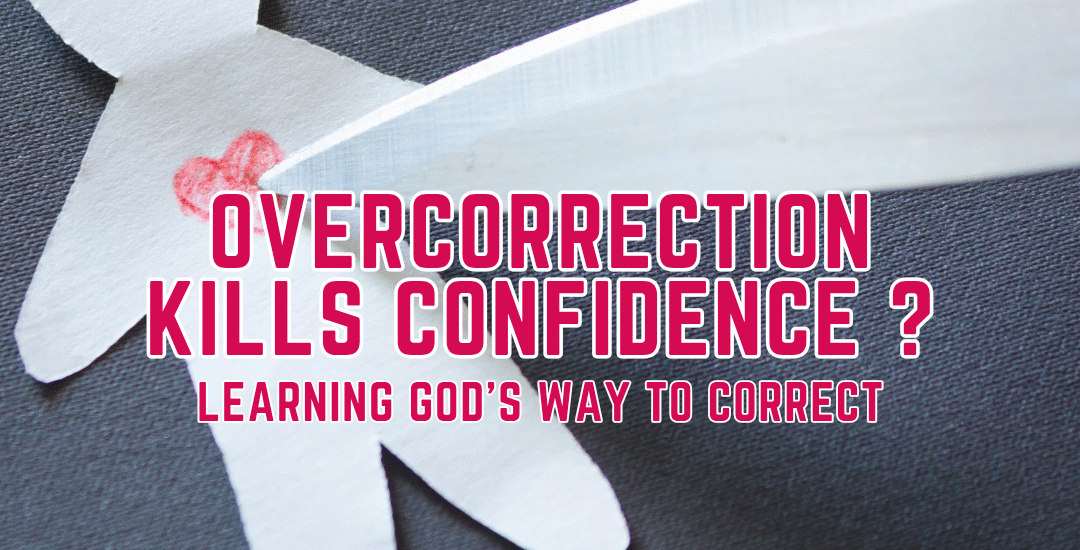
Correction is necessary. But overcorrection? That kills confidence. Many times, correction is done to establish control rather than to inspire confidence. We think we’re helping, but sometimes we’re actually hindering growth.
Why do we correct others?
Is it because we truly care—or because we want to feel superior? Constant correction reverses its intended effect. Instead of shaping a person, it can slowly shrink their confidence.
Psychologists tell us that when someone is corrected harshly or too frequently, their brain begins to associate effort with fear of failure. Over time, they stop trying altogether. They don’t grow—they freeze.
Research by the University of Michigan’s Institute for Social Research found that people who receive more criticism than affirmation at work or home show lower self-esteem and poorer long-term performance. They become risk-averse and emotionally withdrawn — not because they lack ability, but because they lack affirmation.
Leadership expert Ken Blanchard once said, “Feedback is the breakfast of champions—but it must be served with grace, or it becomes poison.” That’s true in leadership, parenting, ministry, and discipleship alike.
A Personal Reflection
Growing up as a young leader, I experienced correction that often felt harsh, public, and overly dramatic. The words, tone, and timing sometimes felt more like ultimatums than opportunities. The expectation was not transformation—it was conformity.
It felt as though I was being told to “act right” rather than “be right.” Those moments left me confused, cautious, and even fearful to try again. I didn’t realize it then, but overcorrection doesn’t create disciples—it creates distant hearts. It silences creativity, numbs initiative, and breeds insecurity.
But through the years, I’ve discovered that God corrects differently.
The Biblical Model of Correction
The Bible shows us that the Lord’s correction is never about control—it’s always about cultivation. His goal is always restoration, not humiliation.
“My son, do not despise the Lord’s discipline, and do not resent His rebuke, because the Lord disciplines those He loves, as a father the son He delights in.” — Proverbs 3:11–12 (NIV)
God’s correction carries three divine characteristics: timing, touch, and teaching.
1. His Timing Is Perfect
God never corrects too soon, nor too late. His timing is redemptive. He waits until our hearts are soft enough to receive truth without breaking under its weight.
After Peter denied Jesus three times, Jesus didn’t confront him immediately. He waited until after the resurrection—until Peter’s heart was tender and teachable. Then beside the charcoal fire, Jesus simply asked, “Do you love Me?” (John 21:15–19).
That wasn’t condemnation—it was restoration.
In that moment, Jesus didn’t strip Peter of his calling; He reinstated it. That’s divine timing—correction that heals rather than humiliates.
Christian counselor Dr. Larry Crabb once said, “God waits for us to be ready to hear before He speaks to change.” True correction waits for readiness, not reaction.
2. His Touch Is Kind
When God corrects, His hand is gentle. His correction is never meant to crush but to comfort into change.
“A bruised reed He will not break, and a smoldering wick He will not snuff out.”— Isaiah 42:3 (NIV)
Even when Jesus corrected, His tone carried truth wrapped in tenderness. With the woman caught in adultery, He said, “Neither do I condemn you. Go and sin no more.” (John 8:11).
He confronted sin but covered shame. That’s divine kindness in action.
The Apostle Paul reminds us: “Do you show contempt for the riches of His kindness, forbearance and patience, not realizing that God’s kindness is intended to lead you to repentance?” — Romans 2:4 (NIV)
It is His kindness—not condemnation—that transforms us.
Studies in behavioral psychology confirm this biblical truth. Positive reinforcement leads to deeper, longer-lasting change than punishment. In other words, kindness motivates more than criticism. God’s model of correction doesn’t shame us into obedience—it loves us into transformation.
C.S. Lewis captured this beautifully: “God whispers to us in our pleasures, speaks in our conscience, but shouts in our pain: it is His megaphone to rouse a deaf world.”
Even His painful corrections are loving attempts to awaken us, not destroy us.
3. His Teaching Brings Transformation
God’s correction doesn’t stop at pointing out the wrong—it points us toward what’s right. His teaching brings renewal, not resentment.
“No discipline seems pleasant at the time, but painful. Later on, however, it produces a harvest of righteousness and peace for those who have been trained by it.” — Hebrews 12:11 (NIV)
The Greek word for “discipline” here is paideia—from which we get the word “education.” It means training through relationship. In other words, God’s correction is always relational, not mechanical. He teaches through love, not lectures.
When Jesus taught the disciples, He didn’t just expose their failures; He equipped their faith. When they feared the storm, He didn’t scold them endlessly—He stilled the sea and asked, “Where is your faith?” (Luke 8:25). His questions guided reflection, not rejection.
Modern education studies support this: learners grow best when feedback includes grace-filled guidance—a balance of honesty and encouragement. The Bible was ahead of the research all along.
The Kite Principle
Correction is like flying a kite. There are moments you pull the string—to guide and protect—and moments you release it—to let the kite soar. The art lies in knowing when to do which.
If you pull too hard, you break it. If you never pull, it drifts away.
The secret is balance—just like God’s approach with us.
The best mentors, parents, and leaders don’t control the kite; they coach its flight. They understand what Paul meant when he wrote, “Let everything you do be done in love.” — 1 Corinthians 16:14 (ESV)
Love is the difference between correction that crushes and correction that cultivates.
Final Reflection
Overcorrection may control behavior, but only kind correction transforms the heart.
Let’s learn from the Lord’s way—His timing, His touch, and His teaching.
The goal of correction is not compliance but confidence. It’s not about making people obey—it’s about helping them become who God created them to be.
As pastor and author Max Lucado wrote, “God loves you just the way you are, but He refuses to leave you that way. He wants you to be just like Jesus.”
That’s correction with purpose. That’s transformation through tenderness. That’s the way of the Lord
Reflection Questions:
1. When you correct others, is your goal control or cultivation?
2. How has God’s kindness led you to repentance in your own life?
3. Who in your life might need your timely, kind, and teaching correction today?
Let’s Prayer Together:
Lord, teach me to correct like You do—with wisdom in timing, gentleness in touch, and love in teaching.
Help me reflect Your kindness that leads to repentance, not rebellion.
When I lead, parent, or guide others, may my words build confidence, not crush it.
In Jesus’ name, Amen.