In our day and age, many are afraid to miss out.
Maybe it is the fear of being left behind.
Maybe it is the fear of not being seen.
Maybe it is the fear of not impressing the people whose validation we crave.
Maybe it is simply the fear of being alone — because everyone else seems to be somewhere, doing something.
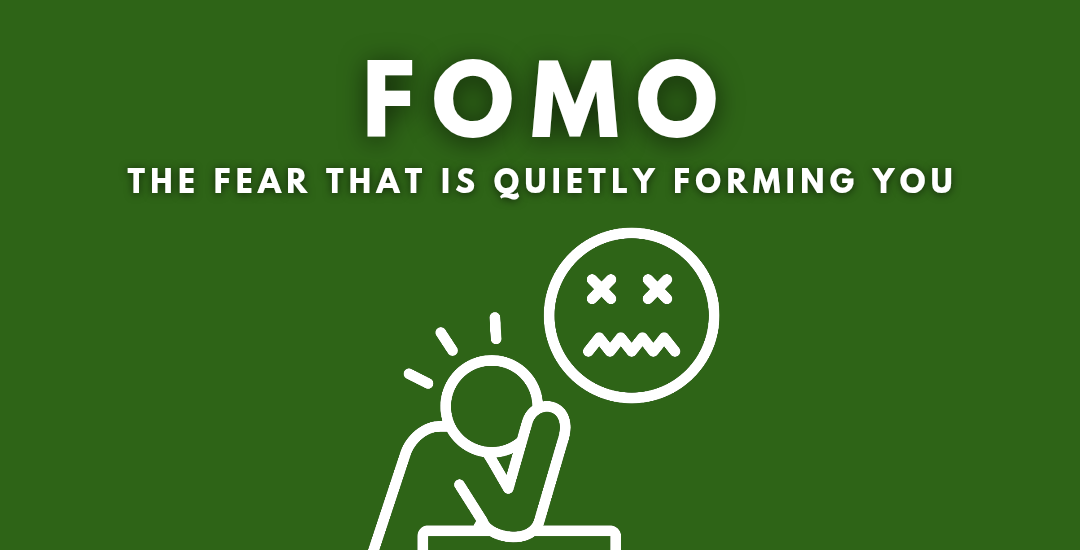
FOMO — the fear of missing out — has become a silent driver of decisions.
And while some of these motivations may sound harmless, living under the influence of FOMO is not healthy. It quietly shapes you into someone who constantly needs affirmation — from words, gifts, invitations, platforms, or presence. It produces a subtle dependency on being included.
It makes you needy.
It makes you performative.
It makes you restless.
As Brené Brown once said, “Staying vulnerable is a risk we have to take if we want to experience connection.” But FOMO is not vulnerability — it is insecurity disguised as connection.
I know this because I was that person.
Growing up — and even as a young pastor — I felt the need to be in every group, every conference, every meeting. Sometimes I attended not because I was called to be there, but because I was afraid not to be there. I wanted to be seen. I wanted to be known. I wanted to be part of something.
There were moments I was present physically, but not present purposefully.
And that is the tragedy of FOMO — you can be everywhere and still not be where you are meant to be.
Jim Elliot once wrote, “He is no fool who gives what he cannot keep to gain what he cannot lose.” But FOMO makes us trade what cannot be lost for things that never truly satisfy.
As the years passed and I grew older in ministry, I began to realise something profound:
Losing out is often better than living scared.
There is a difference between being ready for the Lord and being driven by fear.
I remember hearing sermons about the rapture growing up — the urgency of not missing out. The preacher was not wrong. The call to readiness is biblical. But sometimes the receiver is not mature enough to distinguish between holy urgency and unhealthy anxiety.
Scripture calls us to readiness, yes — but not to panic.
It calls us to faithfulness, not frenzy.
“Therefore, laying aside all filthiness and overflow of wickedness…” (James 1:21 NKJV)
The Bible repeatedly tells us to rid ourselves of worldly desires. The Greek word for “lay aside” (apotithēmi) means to deliberately strip off — like taking off a garment that does not belong to you anymore.
FOMO is one of those garments.
C.S. Lewis wisely observed, “When we lose one blessing, another is often most unexpectedly given in its place.” But we will never receive the second blessing if we are too busy chasing the first.
It is time to stop living under that spirit.
It is okay not to attend that meeting.
It is okay not to be in that group.
It is okay if you do not impress the leader, pastor, or boss.
It is okay if you do not own the latest gadget.
It is okay.
It is okay.
It is okay.
The greatest satisfaction does not come from avoiding missing out — it comes from choosing what to leave out.
There is power in leaving things out.
Dallas Willard once said, “You must ruthlessly eliminate hurry from your life.” FOMO is one of the chief architects of hurry. It convinces us that if we slow down, we will fall behind.
But the Kingdom does not advance through hurry — it advances through obedience.
As I grew older, I realised that positions, places, promotions, presents, and even people are not worth more than being faithful, obedient, and deeply in love with Jesus Christ.
I stopped going to many meetings.
And it was okay.
If people do not know your name, it is okay.
If you are not in the inner circle, it is okay.
If you are unseen but obedient, that is more than okay — that is powerful.
Mother Teresa once said, “God has not called me to be successful; He has called me to be faithful.” That truth dismantles FOMO completely.
Jesus never chased platforms.
He withdrew often.
He said no often.
He disappeared into mountains while crowds were looking for Him (Luke 5:16).
If the Son of God was not afraid of missing out, why are we?
The irony is this:
FOMO promises significance but produces insecurity.
Obedience may cost visibility, but it produces peace.
At the end of your life, you will not stand before conferences, committees, or critics.
You will stand before Christ.
And on that day, it will not matter what you attended. It will matter what you obeyed.
A.W. Tozer wrote, “The man who has God for his treasure has all things in One.” When Christ becomes enough, FOMO loses its grip.
FOMO will exhaust you.
Faithfulness will anchor you.
Choose anchor over applause.